How to play Warfare
- Pick a countryAny of 128 in 1939, or World War 3 of 2030. Each has its own commander, strengths and units.
- Strike firstYour first order is an attack: a strike force over a weak neighbour's border. The province falls in about a minute.
- Win the thirty daysHold 55% of the world's victory points, or the most when day 30 ends. A Blitz war takes about half an hour.
Opens in this tab. No download, no account. Browse every country
Warfare puts you in charge of a nation on a single, continuous map of the whole world. You can start in 1939, with infantry divisions, biplanes and battleships, or in 2030, the Machine War, with robot brigades, drone swarms and hypersonic missiles. Time keeps moving while you plan: factories produce, armies march and rival nations scheme on their own. Hold 55% of the world’s victory points and you win; if nobody manages that, the war ends after 30 days and the side with the most points wins.
1. Choose a nation and a doctrine
There are 128 playable nations, from great powers to small states. Each one has its own commander, its own national strengths and weaknesses, and its own home-grown equipment designs. A large industrial power can out-produce its neighbours, while a small country has to rely on terrain, alliances and clever timing. Before the game starts you also pick a doctrine, which shapes how your army fights and what it is cheap to build.
2. Learn by fighting
A new game opens with a guided first battle. Your general has a strike force standing by on the border of a weak neighbour: you select it, order the attack, confirm the declaration of war and watch the province fall. The neighbour is caught off guard, so it is a fight you can win. Only then does the tutorial turn to the home front: recruit troops in your capital, put up a building and start your first research project. Each step waits until you actually do it, and the war's clock is held while you read. You can skip it, or replay it any time from Settings.
Blitz or Campaign
Before you begin, choose how fast the war is fought. In a Blitz war a game day takes about a minute, the first battle is seconds away and the thirty days are over in about half an hour; the war waits while you are away. In a Campaign war one game hour is one real hour, the war takes up to a month and carries on while you are away, with your generals taking command after eight hours. You can pause and change speed in both.
3. Build an economy
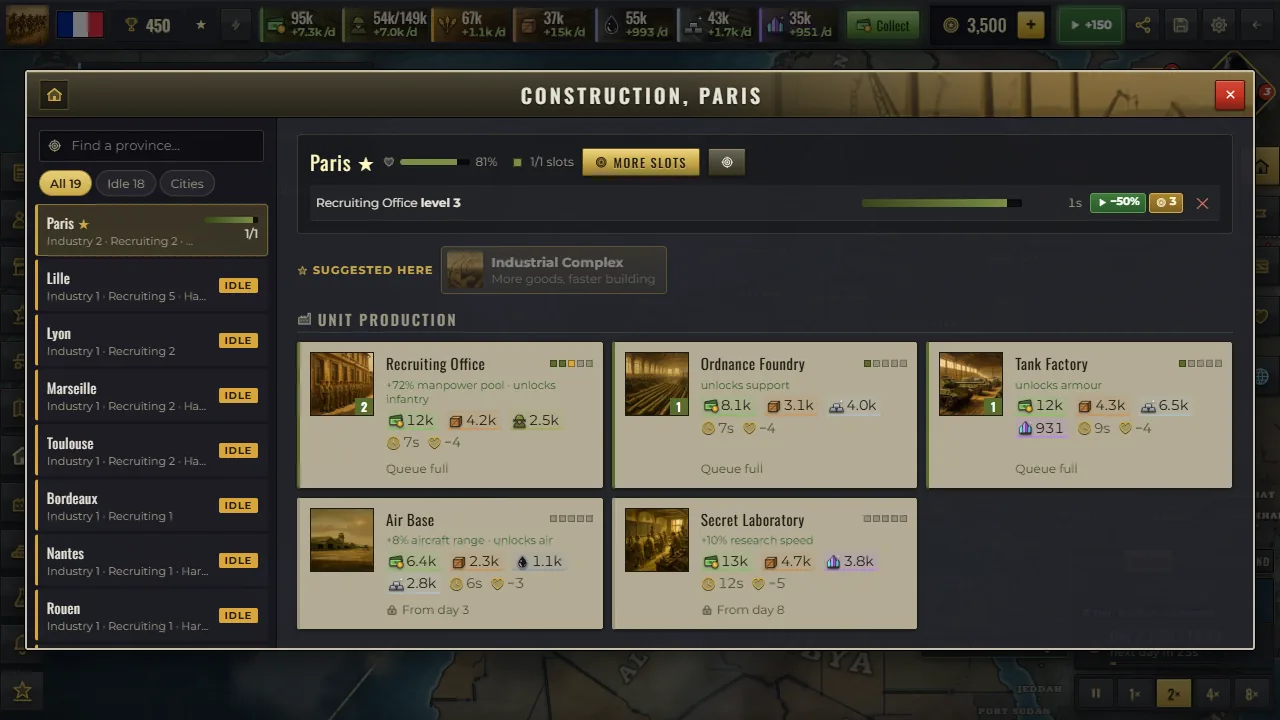
Every province produces resources depending on its terrain, farmland feeds your people, hills and mountains are rich in ore, cities provide manpower and money. Buildings turn those resources into power:
- Infrastructure and Industrial Complexes raise a province's output.
- Recruiting Offices, Ordnance Foundries and Tank Factories let you train infantry, artillery and armour.
- Air Bases and Naval Bases unlock aircraft and warships.
- Bunkers, Fortresses and Anti-Air Batteries harden your borders.
- A Secret Laboratory speeds up research, a Field Hospital returns wounded soldiers, a Propaganda Office and Public Amenities keep morale high.
Morale decides how much a province produces. It cannot simply be bought: press + next to a province's morale to set national policy (taxes, a minimum wage and welfare, a culture and entertainment programme), build amenities, hold a festival or send emergency relief. Morale drifts towards its target hour by hour, and each policy can be changed once a day.
Surplus resources can be traded on the resource exchange, an order book where every nation buys and sells, so a country rich in oil but short of food can still keep its army supplied.
4. Raise an army
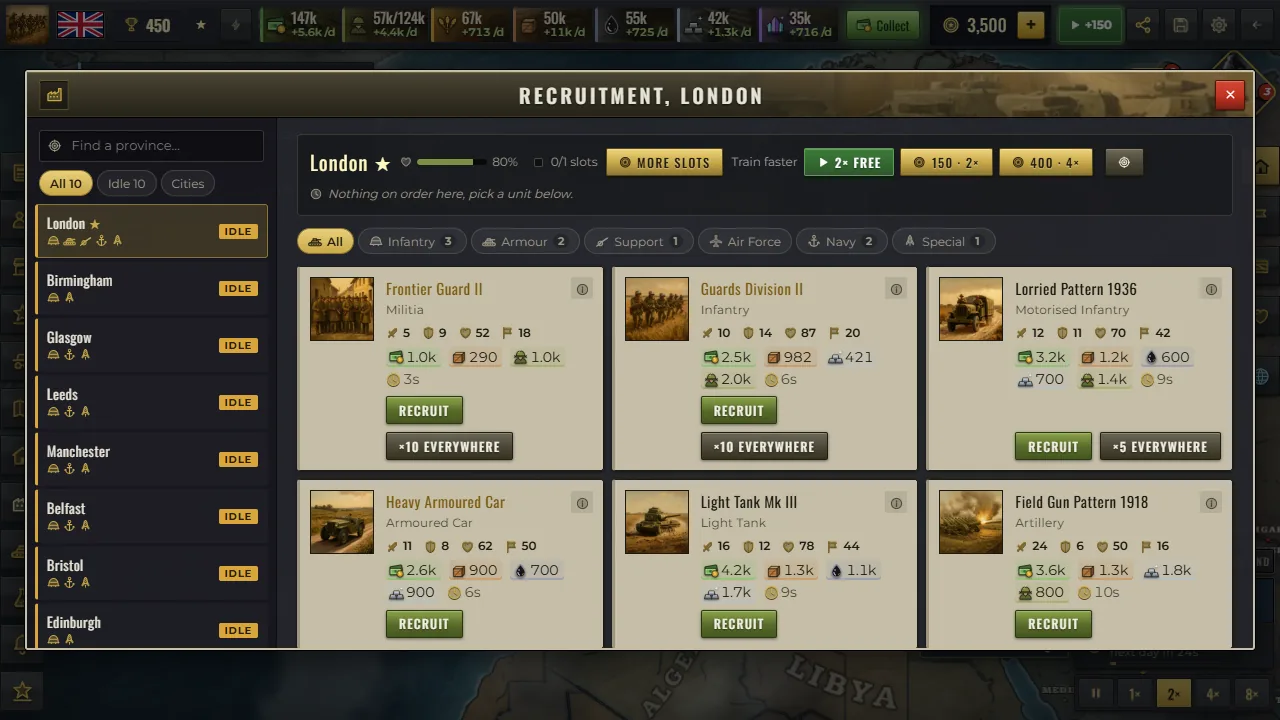
Units are grouped into infantry, armour, support, air force, navy and special forces. Infantry, militia, mountain troops and paratroopers hold ground; light, medium and heavy tanks break through it; artillery, anti-tank and anti-air guns support the line. In the air, interceptors fight for control of the sky while tactical, naval and strategic bombers strike targets on the ground and at sea. Submarines, destroyers, cruisers, battleships, carriers and troop transports fight for the oceans. Agents, rockets and, late in the war, atomic bombs complete the arsenal.
5. Fight battles
When armies meet, they exchange fire every half hour of game time. A few rules decide most wars:
- Only the ten best values count. A stack uses at most its ten best attack or defence values against each armour class. A stack of thirty units hits no harder than a stack of ten, so a strong front is a line of formations, not one giant pile. Use Split to divide a stack.
- Attackers attack, defenders defend. An army on its own ground fights with its defence values; one that advances into enemy territory fights with its attack values. Infantry defend about twice as well as they attack, which is why tanks lead offensives and infantry hold the line. Fighting on home soil adds another 15%.
- Terrain matters. Plains and farmland favour fast armour; hills, mountains, forests, marshes and jungles slow attackers down and protect defenders. Cities are hard to take.
- Beaten armies retreat. A stack reduced below a third of its strength is broken and can be withdrawn; below a fifth it falls back on its own. Surrounded armies have nowhere to go and fight on, so encircling the enemy is the surest way to destroy them.
6. Research new weapons
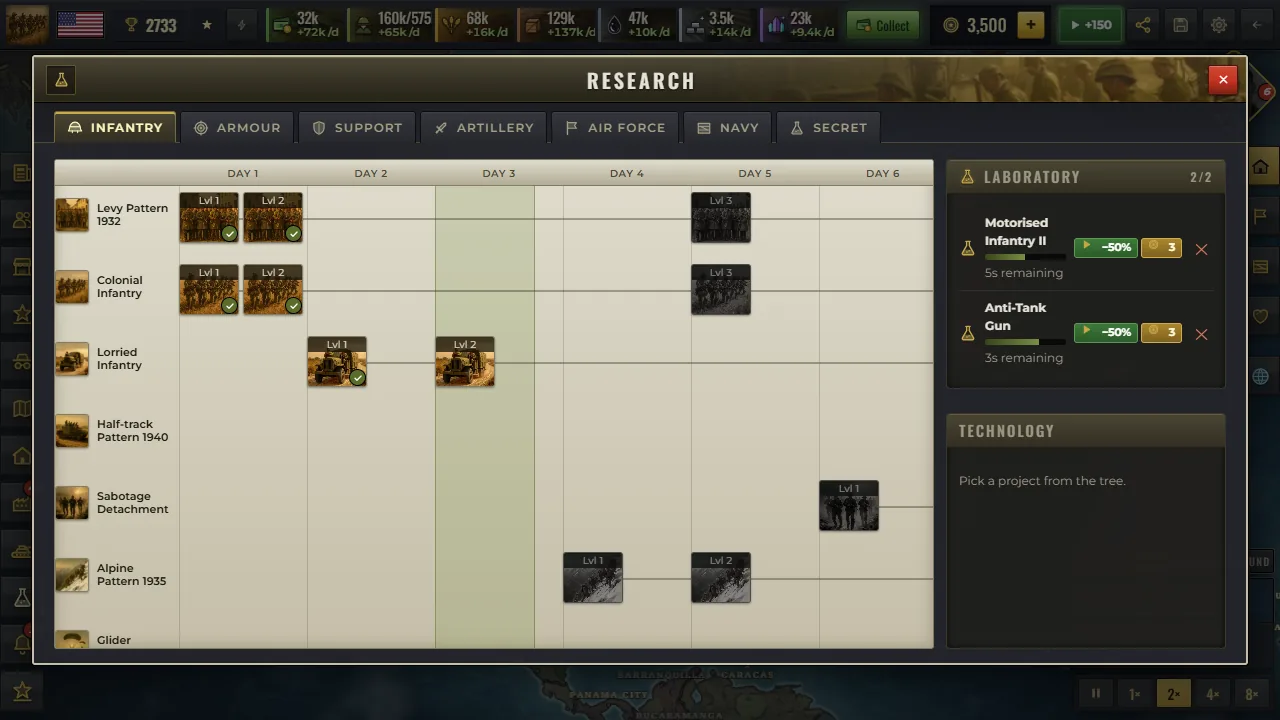
Research unlocks better versions of every unit and building. Each nation can research a limited number of projects at once, so choosing between better tanks, faster aircraft or stronger fortifications is one of the big strategic decisions of every game.
Timers and speeding things up
Every timer in the game, construction, training, research, and how long an army needs to reach its destination, is shown in real minutes and seconds at the speed you are playing. Select an army and point at any province to see the route it would take and how long it would need, before you give the order. Anything that is running can be hurried: watch a short advert to take a quarter of its total time off (once per job or march), or spend gold to finish it at once. A hurried march still stops short of enemy troops, speed buys distance, never a skipped battle.
7. Diplomacy, alliances and espionage
You do not have to fight alone. Form coalitions with other nations, share victory with allies and use agents to spy on rivals, sabotage their production or stir up unrest. The AI nations do the same, and they will notice a neighbour who grows too strong.
8. Win
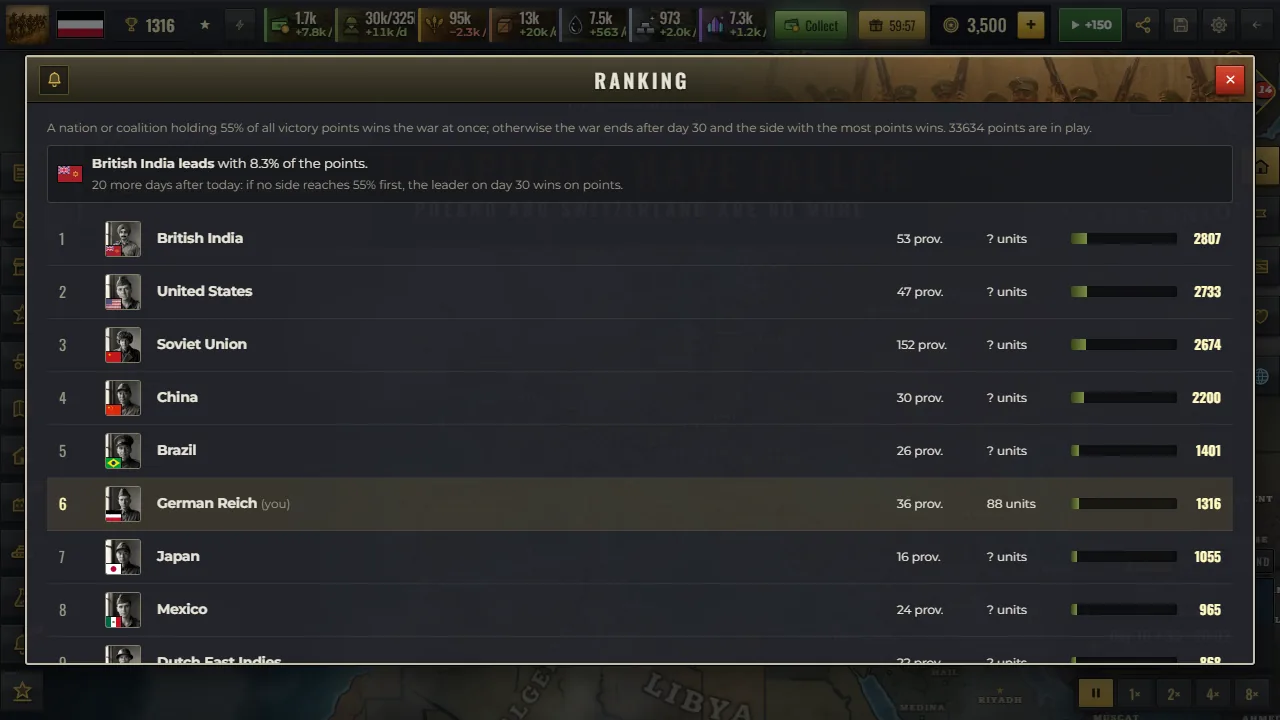
The game is won by holding 55% of the world’s victory points, alone or together with your allies. A war lasts 30 days at most: if no side has reached 55% by midnight on day 30, the war ends there and the side holding the most victory points wins on points (level sides are split by provinces held, then by the strength of their armies). The clock shows the day out of 30, and your commander warns you five days before the end. You can pause or change the speed at any time, and the game saves itself in your browser every two minutes, so you can close the tab and pick up where you left off.
Frequently asked questions
How long does a war last?
Thirty game days at most, and you choose how fast they pass. A Blitz war is fought in one sitting: a game day takes about a minute, so the whole war is over in about half an hour, and it waits while you are away. A Campaign war runs in real time: a game day is a real day, so it takes up to a month (about four days at 8×), and it carries on while you are away. Either ends sooner if a nation or coalition reaches 55% of the victory points. Multiplayer matches end on day 30 too, and the result goes on the leaderboard.
Is Warfare free?
Yes. The whole game is free to play, and nothing has to be bought to play or to win. Optional packs of gold, the in-game currency, can be bought to speed things up, see About & pricing. You can also earn gold by choosing to watch an advert.
Do I need to download anything or make an account?
No. Warfare runs in any modern browser on desktop or laptop. Your game is saved on your own device.
Is it multiplayer?
Both. Most players start with a single-player war against computer-controlled nations that build, research, form alliances and invade on their own. Multiplayer matches against other people are on the start menu's Multiplayer tab.
Who makes Warfare?
Warfare is developed and published by WantedAudio GmbH in Frankfurt am Main, Germany. All map data, artwork and code are original. Questions: support@playwarfare.com.