How Battles Work in Warfare: The Rules That Decide Wars
Battles in Warfare are not decided by who owns the biggest pile of units. They are decided by a handful of rules that you can learn in ten minutes. Learn them and a smaller army can beat a larger one.
The rhythm of a battle
When armies meet, they exchange fire every half hour of game time. A single province can see many rounds before one side gives way, which gives you time to react: bring reinforcements, split a stack, or pull back a force that is losing. Nothing in a battle is instant, so a battle you can see coming is a battle you can prepare for.
Rule 1: only the ten best values count
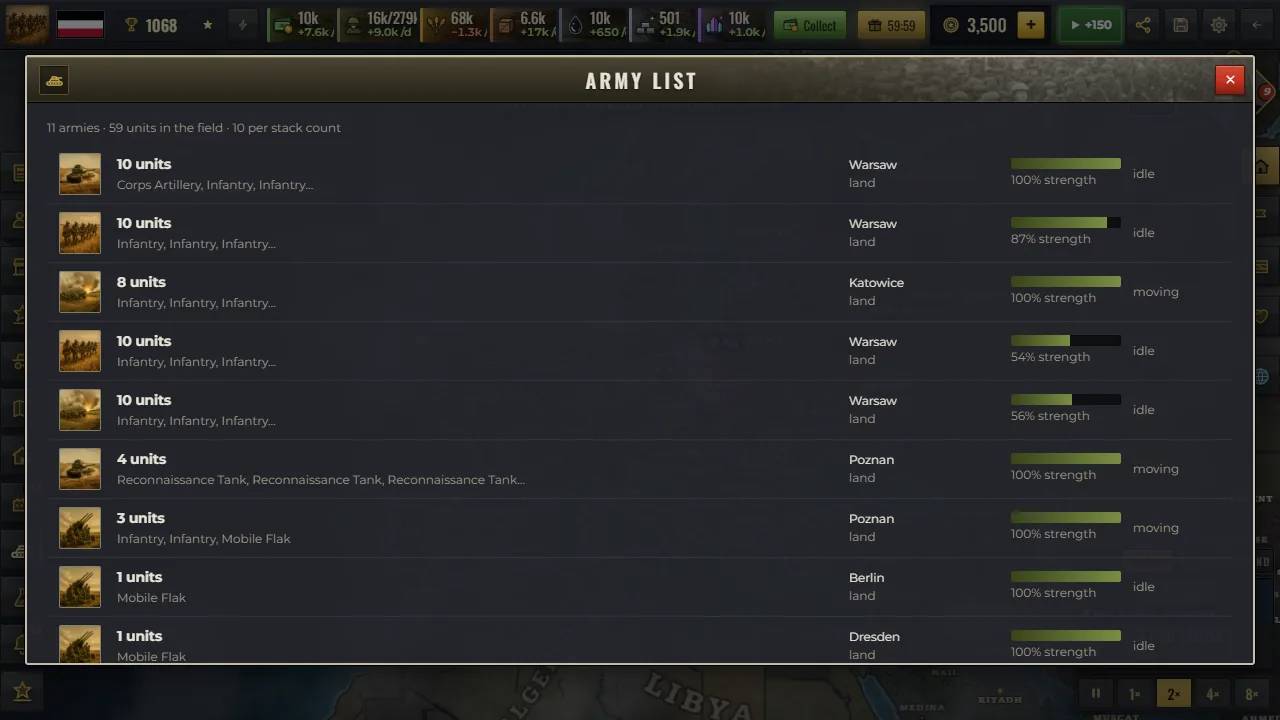
A stack uses at most its ten best attack or defence values against each armour class. A stack of thirty units hits no harder than a stack of ten. The consequence is the most important idea in the game: a strong front is a line of formations, not one giant pile. If you gather everything in one province, the surplus units add upkeep and no firepower. Use the Split command to divide a stack, spread it over several provinces on the front and keep a second line behind.
The same rule helps the defender in reverse. A small, well-chosen stack of the best defenders can hold a province against a much larger attacking stack, because the attacker's extra units do not count.
Rule 2: attackers attack, defenders defend
An army on its own ground fights with its defence values. An army advancing into enemy territory fights with its attack values. These are different numbers. Infantry defend about twice as well as they attack, which is why infantry hold the line and tanks lead offensives. Tanks are the opposite: strong on the attack, much less so when sitting still.
That gives you a simple division of labour. Infantry and fortifications hold the territory you own. Armour, supported by artillery and aircraft, is a hammer you swing at a chosen point and then pull back to repair.
Rule 3: home soil adds 15%
Fighting on your own territory adds another 15%. It sounds small, but it stacks with terrain, fortifications and the defender's advantage in Rule 2. A well-prepared defender in the hills of his own country can be nearly impossible to dislodge with equal numbers. The reverse is true for you: an offensive across the border has to beat all of those at once, so make sure you are far stronger at the point you attack.
Rule 4: terrain
Plains and farmland let fast armour move freely. Hills, mountains, forests, marshes and jungles slow attackers and protect defenders. Cities are hard to take. The terrain guide lists the numbers; the short version is that you should attack across open ground and defend in broken ground.
Rule 5: beaten armies retreat
A stack reduced below a third of its strength is broken and can be withdrawn on your order. Below a fifth it falls back on its own. This protects units from being ground to nothing, and it means that a battle is often decided not when the last soldier falls but when one side breaks.
The exception is the surrounded army. An army with nowhere to retreat to fights on, and fights to the end. Encirclement is the surest way to destroy an enemy. A spearhead that cuts behind the front is worth more than a frontal assault, because it turns every enemy stack in the pocket into a force that cannot escape.
Combined arms
Different units cover each other's weaknesses. Infantry, militia, mountain troops and paratroopers hold ground. Light, medium and heavy tanks break through it. Artillery, anti-tank and anti-air guns support the line. Interceptors fight for control of the sky while tactical, naval and strategic bombers strike targets on the ground and at sea. Submarines, destroyers, cruisers, battleships, carriers and troop transports fight for the oceans. A force of only one type will meet the enemy's answer to it. A mixed force has no single weakness to exploit.
A simple plan that uses all of this
- Hold your border with infantry in the best terrain you own, split into several stacks.
- Build a mobile armoured group behind the front.
- Pick a point where the enemy front is thin and the ground is open.
- Attack with the armoured group, supported by artillery and air cover, and aim not at the nearest province but at the one behind the enemy army.
- Once the pocket is closed, let the trapped stacks fight their last battle and move on.