Your First Hour in Warfare: A Step-by-Step Opening
Warfare is a real-time game, which means the opening matters more than it looks: everything you start now is finished while you are doing something else. A Blitz war runs a game day in about a minute and a Campaign war runs one in a real day, but the order of the opening is the same. This is a plain one that works for almost any country.
Before the first click: choose with your eyes open
There are 128 playable countries and they are not equal. A great power such as the United States, Germany or the Soviet Union has many provinces, a deep manpower pool and money to spend on three things at once. A small country has a few provinces, a strong national bonus and one clear way to win: defend good ground, pick allies and wait for the right moment. If this is your first war, choose a mid-sized country with a coast and at least one friendly neighbour. You will meet every system without being crushed by any of them.
Read the country's briefing on its page in the country list first. It tells you the commander, the signature bonus, the strengths and the flaw. The flaw is the part people skip, and it is the part that decides where you will be weak.
You also choose a doctrine. If you are unsure, take the one that matches your first plan: Allied for defence and industry, Axis for armour and speed, Comintern for a large army that is cheap to raise, Pacific for a coastal or island country. The doctrine guide covers the trade-offs.
Minute one to ten: the economy comes first
Select your capital. Everything you can build is built in a province, and the capital is the best one you own. Start with Infrastructure. It raises every resource the province produces by 15% per level and lets armies move through it faster, and it is cheap compared with the factories that come later. Then build a Recruiting Office in a city. It is required before you can train infantry, and each level also enlarges your manpower pool.
Do not build everything at once. Money, goods and metal are limited at the start, and a half-finished factory earns nothing. Queue two or three buildings you can afford, let them finish, and watch the income figures at the top of the screen rise before you queue the next ones.
Minute ten to thirty: a first army and a first scout
Train infantry. Infantry hold ground and cost little, and in the first days a few stacks on your borders are worth more than any single clever unit. Keep them where an attack would come from, not in the capital. If you have a coast, remember that ships can land troops behind your lines, so one stack near a port is cheap insurance.
Look at the map before you move anything. Select an army and point at a province: the game shows the route it would take and how long the march needs in real minutes before you commit. Use that to learn your neighbourhood. Which of your neighbours is weak? Which one is stronger than you and unfriendly? You will answer those questions every day of the war.
Minute thirty to sixty: research and a plan
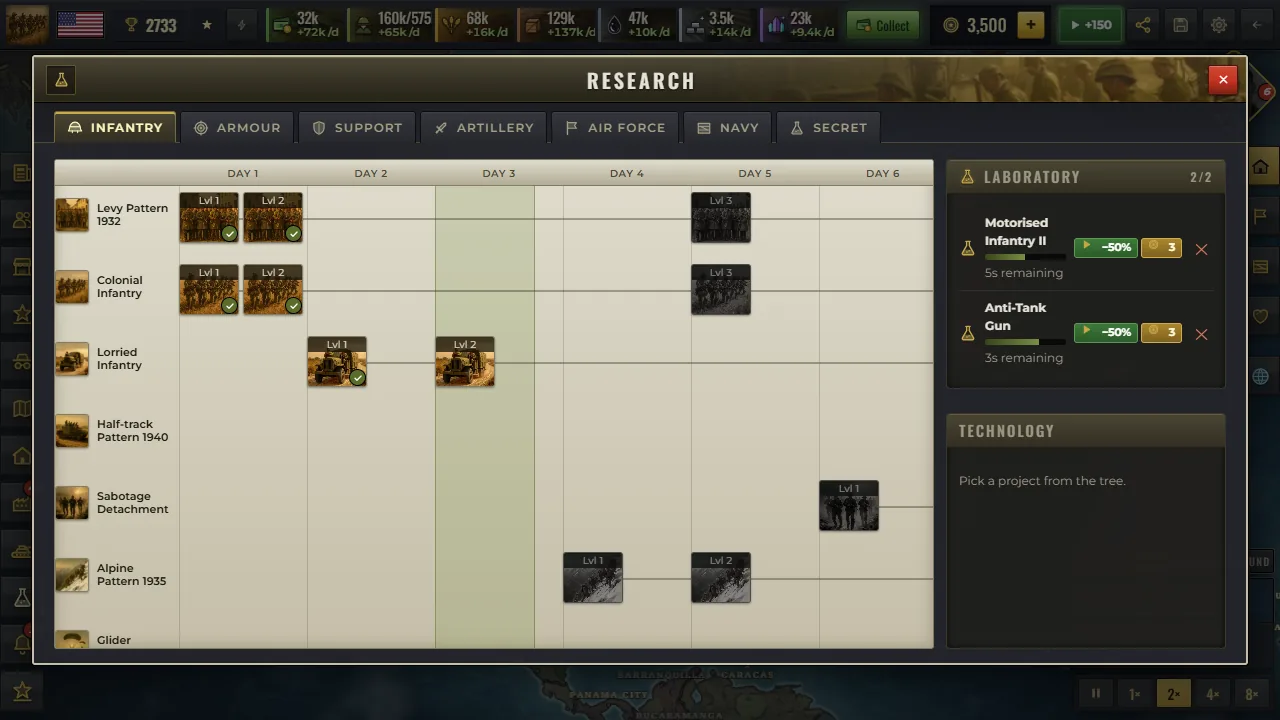
Start a research project as soon as you can. Each country can run only a limited number at once, so an empty research slot is wasted time. Early on, better infantry or a better economy is rarely a wrong choice. Specialise later, when you know what your war looks like.
Then pick a plan and write it down, even if only in your head: a first target, a fallback, and a condition for changing your mind. A good first target is a small neighbour on open ground, because it is cheap to take and each province you add raises your income. A bad first target is a great power next door, however tempting its capital looks.
Mistakes that cost the first war
- Spending everything on soldiers. Units cost upkeep in food, oil, goods and money every hour. An army larger than your economy bleeds the treasury and, if food or oil runs out, slows production. See the economy guide.
- One giant stack. A stack only uses its ten best values in a fight, so thirty units hit no harder than ten. Split armies and use several fronts. See how battles work.
- Ignoring morale. Unhappy provinces produce less. A low-tax, welfare-friendly country can out-produce a harsher one for weeks. See the morale guide.
- Attacking uphill. Mountains give a defender +50% and slow an attacker to a crawl. Go round, or wait for them to come to you. See the terrain guide.
- Playing alone. Every country can ally. The computer-run nations do, and they notice a neighbour who grows too strong.
Then let the war run
A war lasts at most 30 days and ends sooner if someone holds 55% of the world's victory points. In a Campaign war or a multiplayer match you do not need to be at the screen every minute. Set production, give your armies their orders, and come back. If you are away for eight hours or more, your generals take command until you return, so closing the tab is not a loss. A Blitz war is fought in one sitting, and waits for you if you leave. Read how victory works to see what the whole 30 days is building towards.