Economy Guide: Resources, Buildings and Upkeep
Wars in Warfare are won in the factory before they are won in the field. This guide explains the seven resources, what the buildings actually do, why a large army can ruin a small economy, and how to use the resource exchange to cover a shortage.
The seven resources
Every province yields some mix of seven resources, depending on its terrain and what is built in it.
- Money pays for almost everything: buildings, units and research.
- Goods are the output of factories and cities. Buildings and units both need them, and the culture programme (see morale) spends them.
- Metal comes mostly from hills and mountains. Heavy buildings, tanks, guns and ships all eat metal.
- Oil fuels aircraft, ships and mechanised units, and an Air Base needs it to build.
- Rare materials are scarce and needed for advanced equipment; a Tank Factory costs a little, late-war machines cost more.
- Food comes from farmland and feeds your people and your infantry.
- Manpower is the pool of men you can call up. It refills over time towards a ceiling set by your population: every province adds to it, cities add a lot, and each Recruiting Office level adds more.
The first thing to learn about your country is which of these it has too little of. Almost every country is short of at least one, and that shortage tells you what to import, what to avoid building, and often which neighbour you will end up fighting.
What the buildings do
Buildings are built one level at a time, up to five levels, and each level costs more and takes longer than the last. They fall into four groups.
Output. Infrastructure raises every resource a province yields by 15% per level and speeds up movement through it. Industrial Complexes, which need a city, increase goods output and speed up construction in that province. These are the buildings that pay for the others, so they come first.
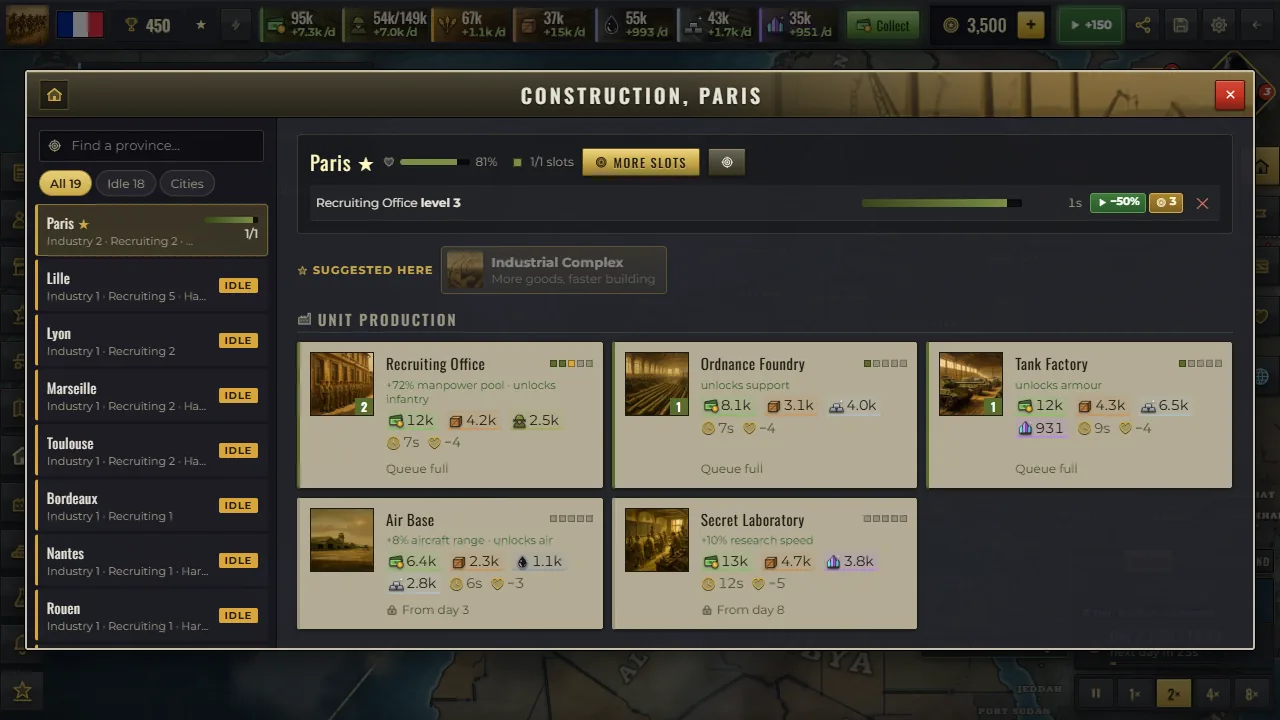
Unlocking units. You cannot train what you cannot build. A Recruiting Office is required for infantry. An Ordnance Foundry unlocks artillery, anti-tank and anti-air guns. A Tank Factory unlocks armour. An Air Base unlocks aircraft, and a Naval Base, which must be on the coast, unlocks warships. Each of these appears in the build menu once the war has run a day or two, so you cannot rush the whole tree on day one.
Defence. Bunkers, Fortresses and Anti-Air Batteries harden a province. They are best on the frontier provinces an enemy must cross, ideally on hills or mountains where the terrain already helps.
Support. A Secret Laboratory speeds research. A Field Hospital returns wounded soldiers to the army. A Propaganda Office and Public Amenities keep morale high.
Upkeep: why more units is not always better
Every unit you field costs upkeep in food, oil, goods and money, every hour. The mix depends on the unit. A mass infantry army eats food; a mechanised army is expensive in oil. Add them up before you recruit. If your oil income is lower than your oil upkeep, your stocks fall until they run out, and running out of food or oil is punishing: production suffers. It is not fatal, but it is a hole you do not want to be in during a war.
The practical rule is to grow income before size. A country that builds Infrastructure and Industrial Complexes for the first days, then recruits, will usually field a larger sustained army than one that recruits at once and starves its own economy.
The resource exchange
The exchange is an order book that every country uses. You can sell a surplus for money and buy what you lack, and prices move with supply and demand. A country rich in oil but short of food does not need to conquer a breadbasket to keep its army fed. A few strategic notes:
- Sell what you cannot use before it is wasted, but keep a reserve of oil and food. They are the two shortages that hurt most.
- Buying has a spread. Constant small trades cost more than a few planned ones.
- If a rival is buying up one resource heavily, that is a signal about what they are building.
Conquest is an economic decision
Every province you take adds its resources to yours, and cities add manpower and goods. But a captured province also needs defending and is often unhappy with its new owner. Prefer targets that fill a gap in your economy: the metal-rich hills you lack, the farmland you need, a port you can build a Naval Base in. A war aimed at your own shortage pays for itself. A war aimed at a prestige target usually does not.