How to Win a Warfare War: The 55% Rule and the Thirty Days
A war in Warfare has a clear end. Either someone holds 55% of the world, or the thirty days run out and the side with the most points wins. Knowing exactly how that is counted changes what you do on day one.
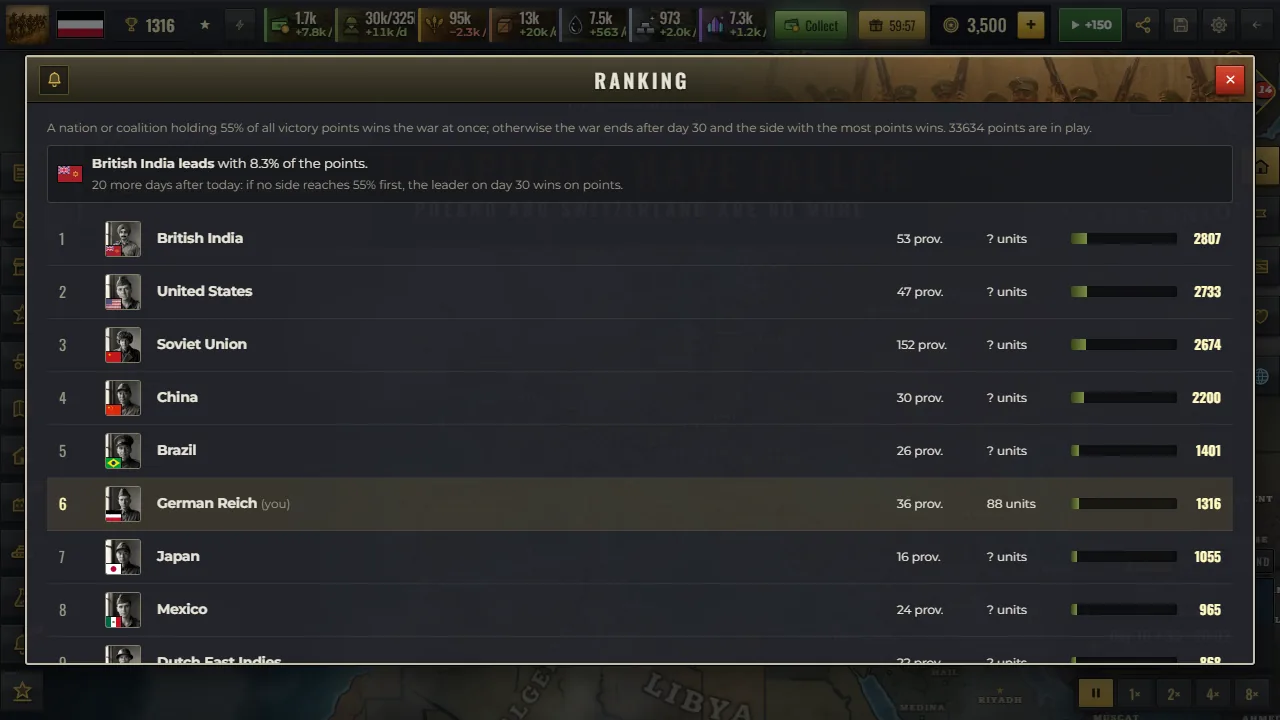
Victory points
Provinces carry victory points, and cities and capitals carry more. You win by holding 55% of the world's victory points, alone or together with your allies. The share is checked continuously, so the war can end the moment a country or a coalition crosses the line.
The ten countries with the most points at the start are listed on the 1939 and 2030 pages. Even the biggest start with a small part of the total. Reaching 55% takes conquest or a large coalition.
The thirty days
A war lasts 30 days at most. If nobody has reached 55% by midnight on day 30, the war ends there and the side holding the most victory points wins on points. If two sides are level, the tie is split by the number of provinces held, and then by the strength of their armies. The clock shows the day out of 30, and your commander warns you five days before the end.
How long thirty days take is your choice in single player. In a Blitz war a game day takes about a minute, so the whole war is over in about half an hour. In a Campaign war a game day is a real day, so a war takes up to a month, or about four days at 8 times speed. In multiplayer the war runs in real time and ends on day 30 too, and the result goes on the leaderboard.
Alliances and shared victory
Allies share a victory. If your coalition holds 55% together, every member wins. That has three consequences:
- A small country can be on the winning side without being the strongest in it.
- Your allies' points count towards your 55%, so helping an ally take a province is as good as taking it yourself.
- Your rivals can do the same. If another coalition is approaching 55%, the rest of the map has a reason to unite against it. The computer-run nations will notice a power growing too strong.
A plan for the whole campaign
Days 1 to 5: build
Develop the economy. Set your policies, raise Infrastructure and a Recruiting Office, train a small army and put it on your borders. Research something useful. Learn who is friendly. See your first hour.
Days 5 to 15: take what is cheap
Expand into the weakest neighbour you can reach on good ground. Every province adds to your income. Meanwhile, build the buildings that unlock the units you will need, and form or join an alliance.
Days 15 to 25: decide
By now you know whether you are heading for 55% or for a points win. If you are the leading power, finish the strongest rival before the coalition against you forms. If you are not, decide which coalition you belong to and make sure it is the one holding the most points.
Days 25 to 30: count
The last five days decide ties. Add up your points and your allies' points against the leader. Every province matters, and a late grab of a few high-value cities can swing the result. Do not start a major offensive that cannot finish in time, and do not leave your own cities weakly held.
Away from the screen
In a Campaign war or a match you do not need to be present all thirty days. The war keeps running, and if you are gone for eight hours or more your generals take command until you return. They will defend what you hold, but they will not execute a plan. For the days that decide the war, be there.
New to the game? Read the full how-to-play guide, then play a war free in your browser.